DAM Cowboy
Search

W29 · July 2026

Content provenance moves from theory to tooling

The question used to be whether you could trace an asset's origin. Now it's whether your systems can prove it at scale. This week: IPTC ships a plain-language guide to C2PA, financial services DAM teaches governance lessons to the rest of us, and AI moderation tools shift from feature flag to production default.

IPTC
topic/c2pa-content-credentialsIPTC

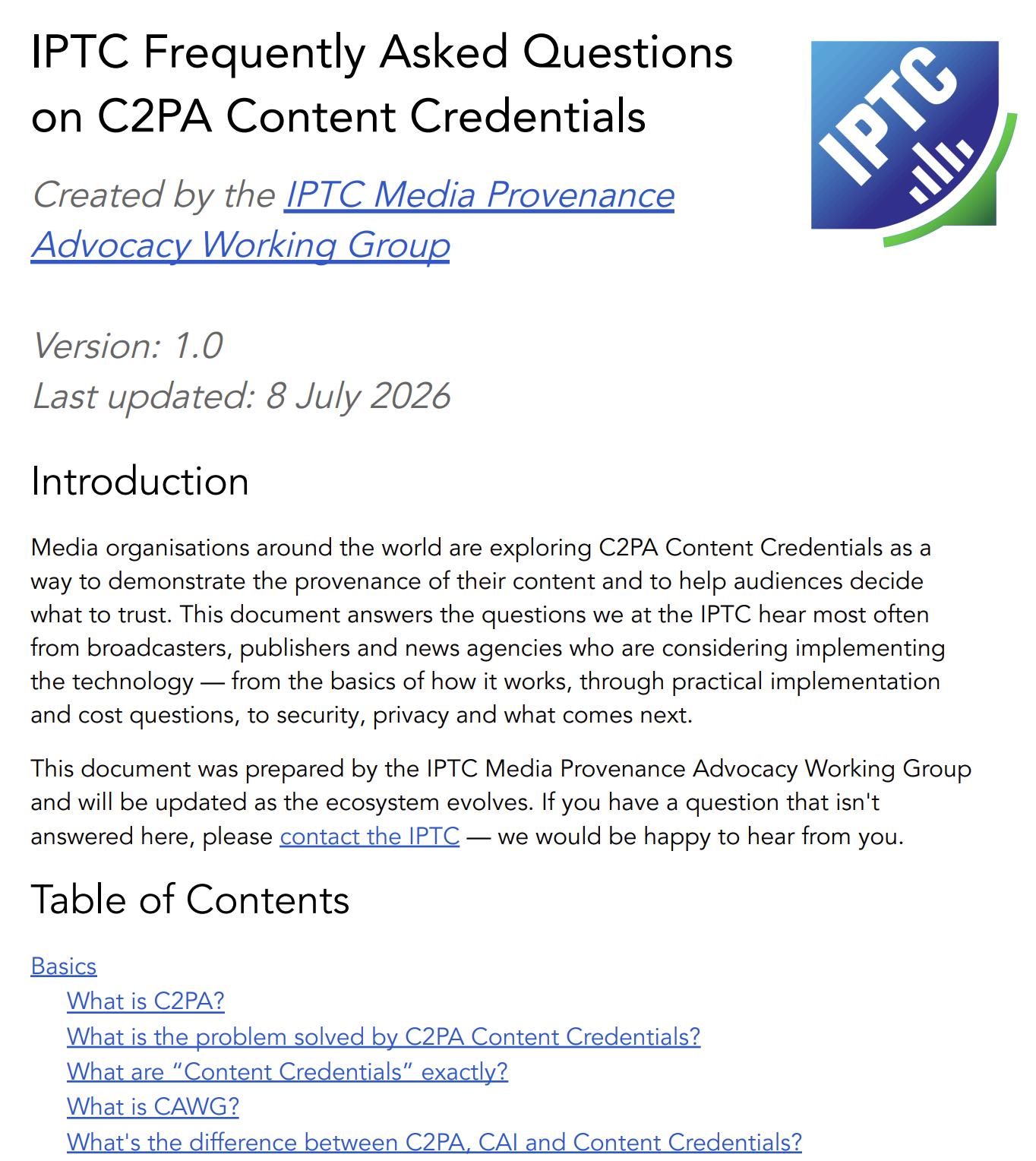
IPTC publishes plain-language FAQ on C2PA Content Credentials

The IPTC has today published a new resource for the media industry: Frequently Asked Questions on C2PA Content Credentials, a plain-language guide for broadcasters, publishers and news agencies who are considering implementing content provenance technology. Interest in C2PA Content Credentials has grown rapidly across the news industry, and with it the number of questions we […] The post IPTC publishes Frequently Asked Questions on C2PA Content Credentials appeared first on IPTC.

Read on IPTC

TL;DR · Why it matters

The IPTC released a new resource aimed at broadcasters, publishers, and news agencies considering content provenance technology. The FAQ translates C2PA implementation questions into operational terms. As synthetic media becomes routine, provenance infrastructure shifts from optional to foundational. Teams that understand controlled vocabulary already grasp the stakes: metadata only works when everyone agrees what it means.
Permalink & share
CMSWire
topic/regulated-industry-governanceCMSWire

What financial services DAM can teach unregulated industries about governance

Financial services couldn't afford a broken DAM. The trust, verification and governance habits that resulted apply to any team scaling content with AI. Continue reading...

Read on CMSWire

TL;DR · Why it matters

CMSWire examines how financial services firms built DAM governance under regulatory pressure and what the rest of us can learn. The habits that emerged (audit trails, role-based access, version control) now matter for any team scaling AI-generated content. Trust and verification workflows that were once compliance overhead are now competitive infrastructure.
Permalink & share
Cloudinary Blog
topic/ai-moderation-productionCloudinary Blog

Building a community photo wall with AI moderation baked in

The post How to Create a Community Photo Wall With TanStack Start, Cloudinary AI Moderation, and Automatic Image Transformations appeared first on Cloudinary Blog.

Read on Cloudinary Blog

TL;DR · Why it matters

Cloudinary published a tutorial showing how to build a community photo wall using TanStack Start and automatic AI moderation. The workflow treats content moderation as infrastructure, not an afterthought. User-generated content used to require human review queues; now moderation runs inline before the asset hits storage. The shift matters less for the technology than for the operational assumption: moderation is default, not optional.
Permalink & share
Acquia Blog
topic/semantic-searchAcquia Blog

Your DAM should understand what you mean, not just what you typed

How Acquia DAM's AI search capabilities work together to deliver better results across every tool your team uses

Read on Acquia Blog

TL;DR · Why it matters

Acquia describes how semantic search changes DAM retrieval from keyword matching to intent understanding. The piece walks through how AI-powered search interprets context, synonyms, and conceptual relationships. The practical test: can your team find the right asset without knowing the exact term someone used six months ago? If not, you are still optimizing for the cataloger, not the searcher.
Permalink & share
Cloudinary Blog
topic/agentic-trafficCloudinary Blog

Why traffic is disappearing and what the agentic era demands

It’s early 2026 and a VP of e-commerce is puzzled by the analytics dashboard in front of them. Organic search traffic is flat and search efficiency is declining, but conversion rates from a small and growing slice of “direct” traffic are anomalously high — six, eight, sometimes 10x the conversion rate of search traffic.  Their analyst […] The post The Invisible Shelf: Why Your Traffic is Disappearing and What the Agentic Era Demands of Your Brand appeared first on Cloudinary Blog.

Read on Cloudinary Blog

TL;DR · Why it matters

Cloudinary explores why organic search traffic is flattening while conversion rates from a small slice of direct traffic are spiking. The hypothesis: AI agents are bypassing traditional discovery paths and arriving with intent. Brands optimized for human browsing may be invisible to agent-driven research. The shift requires rethinking how assets are described, structured, and surfaced. Metadata designed for human search may not work for agents.
Permalink & share
Bynder Blog
topic/ai-content-moderation-governanceBynder Blog

How AI-powered DAM ensures content governance

TL;DR · Why it matters

Bynder outlines how AI-driven moderation enforces content governance at scale. The system flags policy violations, brand inconsistencies, and rights issues before assets go live. Governance used to rely on manual review gates; now it runs as validation logic in the workflow. The practical result: compliance and brand standards become automated checks, not bottlenecks.
Permalink & share

Resource of the week

How to tell if your DAM is actually working

Run through the five questions that separate a functioning DAM from a glorified file share. Takes six minutes.

Run the diagnostic

Field Notes

  • StandardsIPTC released its Q2 2026 NewsCodes update, with a larger sports taxonomy revision still in progress.
  • ConferenceIPTC Managing Director Brendan Quinn joined a Fotoware webinar on content provenance and publishing on June 18.

What's your team's plan for proving content provenance?